
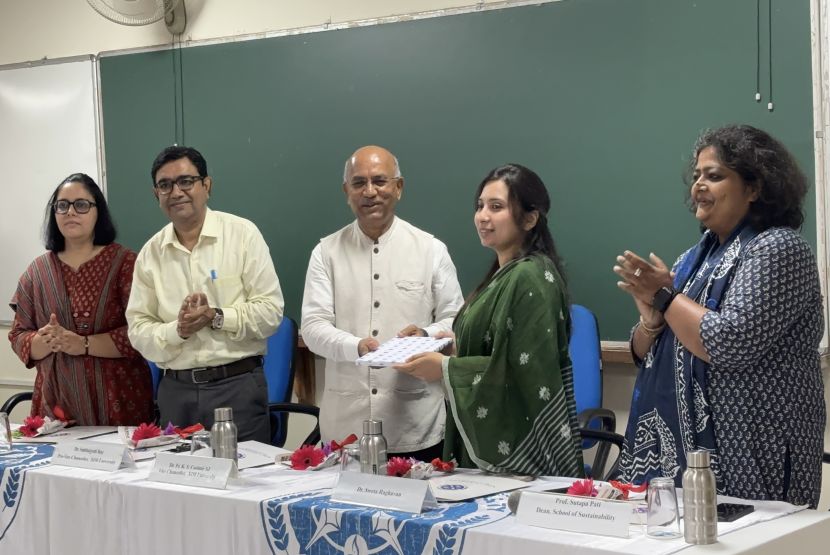
The School of Sustainability, XIM University, organized a seminar titled “Antimicrobial Resistance: Beyond the Laboratory- Integrating Science, Community, and Policy through One Health”, on 3rd July 2026 from10:30 AM to 1:30 PM at SH1, OAB, bringing together renowned experts, researchers, policymakers, faculty members, and students to deliberate on one of the most pressing global public health challenges-Antimicrobial Resistance (AMR).
A major highlight of the seminar was the formal launch of the Odisha Network of AMR, an interdisciplinary initiative that aims to strengthen collaboration in antimicrobial resistance surveillance, research, policy advocacy, and community engagement across the state through the One Health approach.
The program commenced with an inaugural session graced by Rev. Fr. Dr. K. S. Casimir, S.J., Vice Chancellor, and Dr. Subhajyoti Ray, Pro Vice Chancellor, XIM University, who emphasized the importance of interdisciplinary collaboration in addressing emerging global health and environmental challenges. Their addresses reaffirmed XIM University’s commitment to fostering research-driven solutions for sustainable development and public health.
The seminar was convened by Prof. Aradhana Basu, Faculty, School of Sustainability, XIM University. In her address, she emphasized that antimicrobial resistance is no longer confined to hospitals and laboratories but has become a complex environmental and societal challenge that requires coordinated action across multiple disciplines. She highlighted the need for stronger collaboration among researchers, clinicians, environmental scientists, policymakers, and communities under the One Health framework. Dr. Basu also outlined the vision behind establishing the Odisha Network of AMR, which seeks to create a collaborative platform for surveillance, interdisciplinary research, policy development, capacity building, and public awareness to address antimicrobial resistance in Odisha.
Prof. Sutapa Pati, Dean, School of Sustainability, XIM University, delivered the welcome address and emphasized the urgent need for interdisciplinary collaboration to address the growing challenge of antimicrobial resistance through the One Health approach. She also formally announced the launch of the Odisha AMR Network, describing it as a collaborative platform to connect researchers, healthcare professionals, environmental scientists, policymakers, and community stakeholders across the state. She acknowledged Dr. Aradhana Basu for conceptualizing and spearheading the initiative and announced her as the Anchor of the Odisha AMR Network, who will lead and coordinate its activities to strengthen AMR surveillance, research, capacity building, and policy engagement in Odisha.
Delivering the keynote address, Dr. Sweta Raghavan, Advisor on Antimicrobial Resistance to the Government of Karnataka, described AMR as a “silent pandemic” threatening global health, food systems, and economic stability. She explained how the inappropriate and excessive use of antibiotics in humans, animals, and the environment accelerates microbial evolution and resistance. Citing global estimates, she noted that AMR was associated with nearly 5 million deaths in 2019 and could result in an annual global economic loss of USD 3.4 trillion by 2050 if effective interventions are not implemented.
Speaking on the One Health approach, Dr. Bijayini Behera, Professor, AIIMS Bhubaneswar, emphasized that antimicrobial resistance must be addressed through integrated action across human, animal, and environmental health systems. She highlighted that the animal sector accounts for a substantial proportion of global antibiotic consumption, with antibiotics often being used as growth promoters. Sharing findings from surveillance studies, she noted that nearly 90–95% of healthy individuals in India carry antimicrobial-resistant bacteria in their gut, underscoring the hidden burden of AMR within communities.
Dr. Mahesh Chandra Sahu, Scientist, ICMR–Regional Medical Research Centre (RMRC), Bhubaneswar, discussed the evolution of antimicrobial resistance and the growing challenges posed by empirical antibiotic prescribing and self-medication. He stressed the importance of antimicrobial stewardship, routine culture sensitivity testing, and stronger surveillance systems to preserve the efficacy of existing antibiotics, particularly last-resort drugs such as colistin.
Highlighting the environmental dimensions of AMR, Dr. Suraj Kumar Tripathy of KIIT University presented innovative research on decentralized photo-thermal water treatment technology developed in collaboration with Karolinska Institutet, Sweden. The solar-powered technology effectively inactivates antibiotic-resistant bacteria without relying on heavy chemical inputs, offering a sustainable and affordable solution for wastewater treatment in resource-constrained settings.
A landmark outcome of the seminar was the formal launch of the Odisha Network of AMR, envisioned as a multidisciplinary platform that will bring together researchers, clinicians, environmental scientists, public health professionals, policymakers, and communication experts to strengthen antimicrobial resistance surveillance, facilitate collaborative research, promote evidence-based policymaking, and enhance public awareness across Odisha.
The seminar reaffirmed that addressing antimicrobial resistance requires coordinated action extending beyond healthcare settings into environmental management, agriculture, governance, and public engagement. Through the launch of the Odisha Network of AMR, XIM University has taken a significant step toward building an interdisciplinary ecosystem that will support research, innovation, capacity building, and policy interventions to tackle one of the greatest global health challenges of our time.
The programme concluded with a vote of thanks delivered by Prof. Aradhana Basu, who expressed her gratitude to the distinguished speakers, university leadership, faculty members, students, and participants for their valuable contributions. She reiterated XIM University’s commitment to advancing interdisciplinary research and collaborative partnerships through the Odisha Network of AMR, paving the way for sustainable and evidence-based solutions to safeguard public health and environmental well-being.


